
Why Tray Sealers Have Become a Core Packaging System in Modern Food Production
Tray sealing solutions have become one of the most widely adopted packaging methods in the global food industry, particularly for fresh meat, ready meals, and bakery products. As food processing continues to scale up and distribution networks extend across longer geographic distances, packaging is expected to do far more than protect products at the point of sealing. It must actively support food safety, shelf-life stability, cold-chain robustness, and consistent retail presentation—often under conditions involving repeated handling, vibration, stacking pressure, and temperature fluctuation.
Within this environment, sealing reliability has shifted from a secondary concern to a core performance requirement. Research on heat-sealed food packages shows that seal defects are frequently associated with contamination in the sealing area, unstable sealing windows, and material incompatibility—factors that become increasingly critical in high-throughput production where small process deviations can accumulate into measurable failure rates (Ilhan & Dogan, 2021). For protein-rich and high-moisture foods, even minor sealing inconsistencies may result in leakage, accelerated oxidation, microbial growth, and premature shelf-life deterioration.
These realities explain why tray sealers have evolved from simple end-of-line machines into engineered packaging systems. Modern tray sealing solutions function as controlled process units that define the internal package environment, protect structural integrity, and enable reliable integration with downstream automation. In many facilities, tray sealing performance is treated as a critical control point: stable seals support gas retention in modified atmosphere packaging (MAP), consistent skin-pack results in vacuum skin packaging (VSP), reduced purge leakage, and fewer disruptions in inspection, labeling, and case packing.
Tray sealers are especially valued where portion definition and structural stability matter. Unlike flexible pouches that may deform under pressure, trays provide rigid geometry that protects product shape, improves stackability in logistics, and enhances shelf-facing consistency. For retail-oriented products, the tray also becomes part of brand presentation—supporting clean visuals, stable labeling surfaces, and space-saving design.
For these reasons, tray sealers are selected not only for speed, but for their ability to maintain stable packaging outcomes across diverse products, materials, and distribution scenarios. Understanding tray sealer types and functions therefore requires an engineering perspective—one that considers how equipment design, material behavior, and process control interact to determine real-world package performance.
How Tray Sealing Systems Work — And Why Process Stability Matters
At its core, a tray sealing system controls a limited number of critical process variables with high repeatability. Performance is defined less by peak cycle speed than by consistency under normal production variability—changes in tray geometry, product moisture, fill accuracy, material batches, and ambient conditions. These variations are unavoidable in food production; the tray sealer’s role is to absorb them without allowing defects to emerge downstream.
The process begins with accurate tray positioning and mechanical support. Preformed trays must be consistently aligned within the sealing tool so the sealing flange is fully supported during heat and pressure application. Even slight misalignment can cause uneven pressure distribution, increasing the likelihood of localized weak seals that may not fail immediately but become problematic during transport or storage.
Once trays are positioned, the sealing chamber establishes a controlled environment. In top-seal applications, this isolates the sealing area from external disturbance. In MAP and skin-pack formats, chamber control becomes essential. MAP performance depends not only on gas composition, but on the system’s ability to evacuate air, introduce the correct mixture, and retain that atmosphere over time (Caleb et al., 2012). A well-defined gas recipe cannot compensate for unstable sealing conditions or poor seal integrity.
VSP adds a further dimension by physically stabilizing the product. By evacuating air from the chamber and allowing a heated, elastic film to conform closely to the product surface, skin packaging minimizes residual atmosphere and limits product movement—particularly important for irregular or purge-prone items. Packaging guidance emphasizes that such performance must be evaluated as a system outcome of materials, process control, and hygiene, rather than by technology labels alone (IFT, 2024).
The sealing phase itself is the most critical step. Heat, pressure, and dwell time must remain within a stable sealing window that tolerates real-world variability. Research indicates that contamination, unstable sealing windows, and material incompatibility are leading contributors to seal failure, especially under high-speed conditions (Ilhan & Dogan, 2021). Stable sealing delivers multiple outcomes simultaneously: reduced leakage, improved gas retention, predictable opening behavior, and cleaner downstream operations.
After sealing, film handling and trimming ensure consistent pack geometry and appearance. Accurate tension control and clean cutting support reliable labeling and inspection, reducing downstream disruptions. When tray positioning, chamber control, sealing stability, and film handling are managed as a unified process, functional value—food safety, shelf-life predictability, and operational efficiency—emerges naturally.
Different Types of Tray Sealers and When Each Makes Sense
Tray sealers are often categorized by automation level, but in practice the distinction is better understood in terms of how each type fits operational reality.
Semi-automatic tray sealing machines are designed for operations that require flexibility, compact layouts, and moderate production volumes. With a small footprint and adaptable configuration, these machines are well suited for space-constrained facilities such as start-up food manufacturers, central kitchens, and small to medium-sized meat processing plants.
Automatic tray sealing machines are engineered for continuous production environments where packaging consistency, shelf-life control, and line integration are critical. Sealing temperature, pressure, and dwell time are precisely controlled to ensure uniform seal quality across every tray. This level of process control makes automatic tray sealers particularly suitable for fresh meat, seafood, and ready-to-eat products with stringent food safety and shelf-life requirements. These machines are designed for seamless integration with upstream and downstream equipment such as labeling systems, coding units, metal detectors, and inspection stations.
Beyond automation level, tray sealers may operate as standalone units or inline systems. Standalone machines offer simplicity and lower integration demands, while inline configurations provide higher throughput stability and reduced manual handling. Selecting the right type depends on production variability, labor structure, and shelf-life objectives rather than on machine size alone.
Top Seal, MAP, and VSP: Choosing the Right Packaging Format
Packaging format selection determines how a product behaves during storage, distribution, and retail display. Top seal, MAP, and VSP are not competing technologies; they address different product risks and market requirements.
Top seal packaging applies heat and pressure under atmospheric conditions. It is designed for high-speed, straightforward sealing with minimal process complexity, making it well suited to same-day ready-to-eat foods and bakery products where rapid throughput, clean presentation, and efficient production flow are the primary objectives.
Modified atmosphere packaging (MAP) replaces ambient air with a defined gas mixture to slow oxidation and microbial growth. Shelf-life extension depends on gas composition, headspace dynamics, and seal integrity (Caleb et al., 2012). MAP is most effective when distribution distances and storage durations justify controlled atmospheres.
Vacuum skin packaging (VSP) uses a heated, highly elastic film that closely conforms to the product surface, stabilizing the product within the tray and significantly reducing internal movement during handling, transport, and retail display. It improves purge control and visual clarity for premium proteins but places higher demands on materials and process control (IFT, 2024).
Effective packaging strategies often combine formats across product lines, applying each where it delivers measurable value.
How Tray Sealing Is Applied Across Key Food Categories
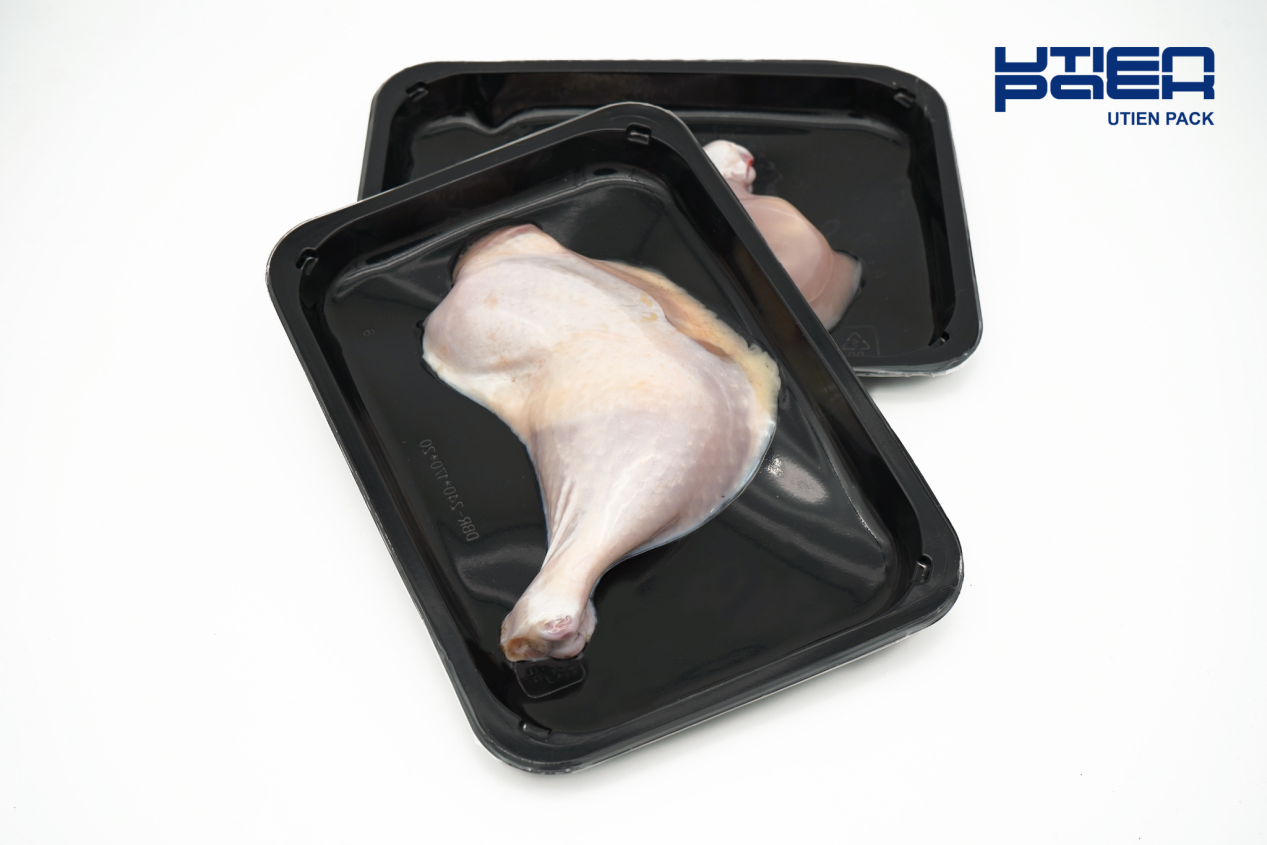
1. Fresh Meat: Managing Shelf Life, Purge Control, and Distribution Stability
Fresh meat represents one of the most technically demanding application environments for tray sealing systems. Products remain biologically active after processing, are highly sensitive to oxygen exposure, and frequently release purge during storage and transport. Modern distribution also relies on centralized processing supplying regional or national retail networks, extending the time between packaging and consumption.
Tray sealing provides a structural advantage over fully flexible formats. Preformed trays protect meat cuts from deformation under stacking pressure and repeated handling, helping reduce mechanical stress on the seal area as handling steps increase.
MAP is widely applied in fresh meat to slow oxidation and inhibit microbial growth, but its performance depends not only on gas composition—packages must also retain the modified atmosphere over time (Caleb et al., 2012). Even small sealing inconsistencies can lead to gradual gas loss during transport, undermining expected shelf-life gains. Tray sealing systems, when properly configured, provide the sealing precision and flange stability needed to maintain consistent residual oxygen outcomes across extended distribution cycles.
For premium cuts and portion-controlled products, VSP is increasingly used to further stabilize the product. Skin packaging minimizes headspace, limits purge movement, and prevents product shifting inside the tray. This improves physical stability during transport and strengthens retail presentation—key for high-value proteins.
In meat operations, tray sealing functions as a practical risk-control measure: reducing leakage, improving shelf-life predictability, and supporting consistent retail presentation, all of which influence returns, waste, and brand credibility.
 2. Ready Meals: Standardization, Line Efficiency, and Retail Consistency
Ready meal production presents a fundamentally different set of packaging challenges compared with fresh protein or bakery products. Meals are typically cooked or assembled prior to packaging, and the dominant risks are no longer raw-material spoilage, but process consistency, component interaction, and distribution stability. Ready meals often contain multiple elements—proteins, carbohydrates, sauces, oils, and seasonings—which makes packaging performance highly sensitive to sealing reliability and internal atmosphere control.
Tray sealing aligns well with these requirements because preformed trays define portion size, compartment layout, and sealing geometry before the product enters the packaging line. This allows filling, sealing, and downstream handling to operate within predictable parameters, even when multiple SKUs or complex recipes are produced on the same line. For ready meal manufacturers, this predictability is essential to maintaining line efficiency while managing frequent changeovers.
In practical applications, MAP is the primary packaging format for ready meals. By evacuating ambient air and introducing a controlled gas mixture, MAP helps slow oxidation of oils, limit moisture-driven texture degradation, and maintain sensory quality during chilled distribution (Caleb et al., 2012). Compared with simple atmospheric sealing, MAP provides a more stable internal environment for meals that may travel longer distances or remain in refrigerated storage for extended periods.
For premium ready meals or products with high visual or structural requirements, VSP is increasingly applied. Skin packaging immobilizes meal components by conforming the film to the product surface, reducing movement during transport and helping prevent sauce migration or component separation. This is particularly valuable for plated-style meals, protein-forward dishes, or products where appearance upon opening influences consumer perception. Packaging research emphasizes that such performance depends on coordinated control of materials, heating profiles, chamber stability, and sealing precision, rather than on the packaging label alone (IFT, 2024).
From a production standpoint, tray sealing plays a central role in overall line stability. Consistent tray geometry improves sealing repeatability, enhances gas retention performance, and supports reliable downstream operations such as labeling, inspection, and case packing. Over long production runs, these factors reduce unplanned downtime and improve overall equipment effectiveness.
In many ready meal facilities, the tray sealer effectively becomes the structural anchor of the packaging line, linking upstream cooking and portioning processes with downstream logistics and retail preparation. When MAP and VSP are applied with stable process control, tray sealing enables ready meal producers to balance shelf life, operational efficiency, and product presentation without compromising throughput.
3. Bakery Products: Protecting Structure and Preserving Visual Quality
Bakery products introduce a packaging priority that differs from fresh proteins or ready meals: physical protection combined with visual integrity, rather than aggressive shelf-life extension. Cakes, pastries, and decorated baked goods are often highly sensitive to compression, vibration, and surface contact. Even minor deformation, smearing, or topping displacement can significantly reduce perceived freshness and consumer acceptance at the point of sale.
Tray sealing is widely adopted in bakery packaging because preformed trays provide a rigid physical barrier between the product and the external environment. By supporting product structure and separating it from the lidding film, trays help prevent direct contact during handling and transport. This separation is especially important for products with delicate surfaces, layered textures, or decorative toppings that define brand identity and visual appeal.
In bakery applications, MAP is commonly applied to help stabilize internal humidity, reduce oxidation of fats and fillings, and slow moisture migration that can lead to surface drying or textural degradation. The modified atmosphere can also reduce condensation and internal fogging, supporting clearer product visibility throughout distribution.
From an operational standpoint, MAP tray sealing enables bakery manufacturers to maintain consistent package appearance across centralized production and multi-site distribution networks. High-transparency lidding films combined with stable tray geometry allow products to be packed in retail-ready formats that perform reliably in both supermarket shelves and foodservice channels. Uniform tray dimensions further improve palletization efficiency and stacking stability, reducing mechanical damage and product loss during logistics.
Across bakery applications, tray sealing functions less as a shelf-life extension tool and more as a presentation and protection system. By preserving structural integrity, visual quality, and handling robustness, MAP-based tray sealing supports brand consistency and consumer trust—demonstrating how the same packaging technology can deliver different value propositions when applied with clearly defined objectives.
What Food Processors Should Consider When Selecting a Tray Sealing Solution
Tray sealers should be evaluated as system capabilities, not standalone machines. Key considerations include process stability under variability, alignment with product-specific risks, and appropriate packaging format selection. Long-term value emerges when tray sealing integrates smoothly with upstream and downstream processes, enabling repeatable quality and operational efficiency.
Utien Pack’s long-term focus on tray sealing—supported by decades of application experience—reflects this engineering-driven approach. By prioritizing precision, system integration, and stability, tray sealing solutions can deliver reliable performance from production floor to retail shelf.
References:
1. Ilhan, I., & Dogan, M. (2021). Understanding the factors affecting the seal integrity in heat-sealed flexible food packages: A review. Packaging Technology and Science, 34(8), 527–546.
https://onlinelibrary.wiley.com/doi/full/10.1002/pts.2564
2. Caleb, O. J., Mahajan, P. V., Al-Said, F. A.-J., & Opara, U. L. (2012). Modified atmosphere packaging technology of fresh and fresh-cut produce and the microbial consequences—A review. Food and Bioprocess Technology, 6(2), 303–329.
https://pmc.ncbi.nlm.nih.gov/articles/PMC7089433/
3. Institute of Food Technologists (IFT). (2024). Food packaging technology considerations for designers and engineers. Comprehensive Reviews in Food Science and Food Safety.
https://ift.onlinelibrary.wiley.com/doi/10.1111/1541-4337.70058
4. Versino, F., Ortega, F., Monroy, Y., & Rivero, S. (2023). Sustainable and bio-based food packaging: A review. Foods, 12(4), 814.
https://pmc.ncbi.nlm.nih.gov/articles/PMC10000825/
Copyright Notice: This article is an original work of Utien Pack and is intended solely for technical communication and learning purposes. Unauthorized reproduction or commercial use is strictly prohibited. For citation or use of this content, please indicate the source and contact our official website (https://www.utien.com) for authorization.
Post time: Jan-04-2026